SendGrid vs Mailgun vs Postmark: 2026 Pricing Compared
SendGrid vs Mailgun vs Postmark in 2026: cost tables at 10k-150k emails, log retention, overage, inbound, validation and dedicated IPs.
SendGrid vs Mailgun is one of the oldest debates in developer email, and Postmark is usually the third name on the shortlist. All three send transactional email through an API and SMTP, all three are owned by larger companies (Twilio, Sinch and ActiveCampaign respectively), and all three have changed their pricing in recent years.
This guide compares what they actually cost at 10,000, 50,000, 100,000 and 150,000 emails a month, then looks at the details that tend to matter after you sign up: how long logs are kept, what happens when you exceed your plan, inbound email, validation, message streams and dedicated IPs. We include Pigeonify in the tables too, and we are explicit about where each competitor is the better choice.
Prices checked against each provider's published pricing in early October 2026; providers change prices often, so confirm on their pricing page before you buy.
The short version
- SendGrid is the cheapest of the three at 50,000 and 100,000 emails, has the largest ecosystem, and has the shortest log history on its entry plan.
- Mailgun is the pick if you need inbound email routing or a built-in email validation product.
- Postmark is the specialist: a strong transactional deliverability reputation, separate message streams and long log retention, at the highest price per email of the three.
- Pigeonify is the lowest-cost of the four at 10,000, 50,000 and 150,000 emails, does not bill overage, and does not offer inbound or validation.
Mailgun vs SendGrid pricing: the plans
SendGrid (Twilio)
- The permanent free plan has been retired. New accounts get a 60-day trial at 100 emails per day.
- Essentials: $19.95/month for 50,000 emails; $34.95/month for 100,000. Overage on the 50k plan is about $1.30 per 1,000. Email activity history is 3 days.
- Pro: from $89.95/month for 100,000 emails, with a dedicated IP, subusers and SSO.
- Premier: custom pricing.
- Marketing Campaigns is a separate product, billed separately.
Mailgun (Sinch)
- Free: 100 emails per day.
- Basic: $15/month for 10,000 emails, $1.80 per 1,000 overage, 1-day log retention, 1 domain.
- Foundation: $35/month for 50,000 emails, $1.30 per 1,000 overage, 5-day logs.
- Scale: $90/month for 100,000 emails, $1.10 per 1,000 overage, 30-day logs, dedicated IP, 5,000 email validations.
Postmark (ActiveCampaign)
- Free developer plan: 100 emails/month, no expiry.
- Basic: $15/month for 10,000 emails, $1.80 per 1,000 overage, 45-day retention.
- Pro: $16.50/month for 10,000 emails, $1.30 per 1,000 overage, inbound processing.
- Platform: $18/month for 10,000 emails, $1.20 per 1,000 overage, unlimited servers, streams and users.
Postmark's model is a low base price with metered volume on top, so its cost grows steeply with volume compared with the other two.
Pigeonify
- Free: $0, 5,000 emails/month (max 200/day), 1-day data retention, no card required.
- Pro: $15/month for 50,000 emails, 7-day retention.
- Scale: $65/month for 150,000 emails, 30-day retention, dedicated IPs as an add-on.
- Enterprise: custom, above 1M emails/month.
- No overage billing. Sending pauses at your plan limit until you upgrade.
Full details are on our pricing page.
Cost at 10k, 50k, 100k and 150k emails a month
The table shows the lowest published monthly price that covers each volume. For Postmark above 10,000 emails we add metered overage to the base price.
| Monthly emails | SendGrid | Mailgun | Postmark | Pigeonify |
|---|---|---|---|---|
| 10,000 | $19.95 (Essentials 50k) | $15 (Basic) | $15 (Basic) | $15 (Pro) |
| 50,000 | $19.95 (Essentials) | $35 (Foundation) | $66 (Platform) to $87 (Basic) | $15 (Pro) |
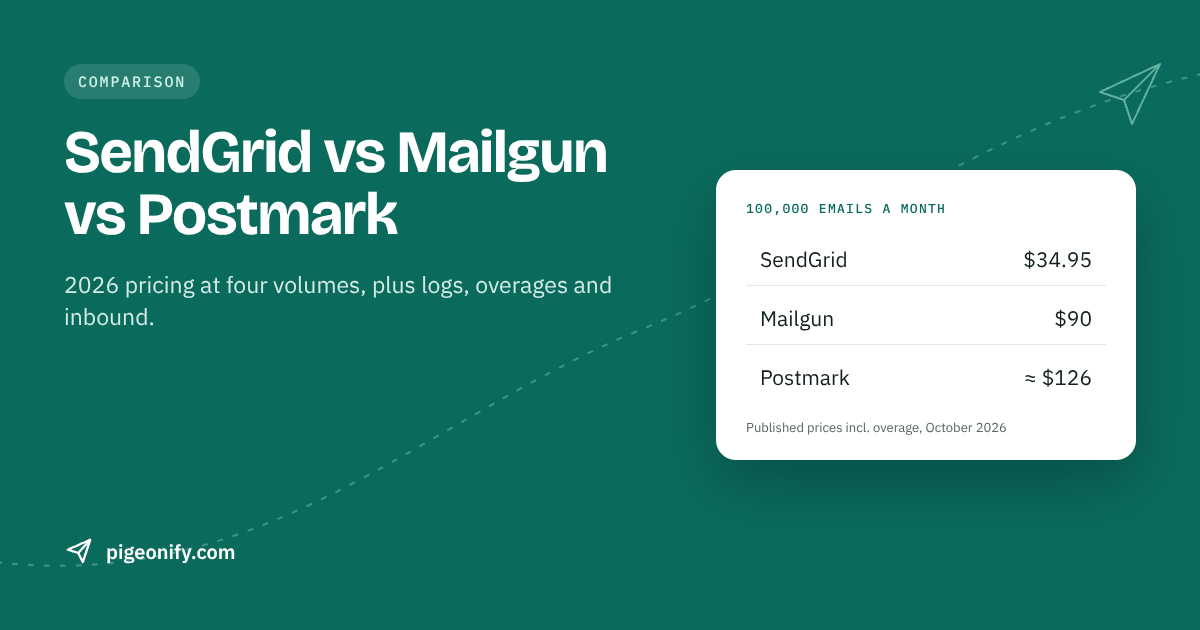
| 100,000 | $34.95 (Essentials) | $90 (Scale) | about $126 (Platform) | $65 (Scale) |
| 150,000 | from $89.95 (Pro) | $145 (Scale + 50k at $1.10) | about $186 (Platform + 140k at $1.20) | $65 (Scale) |
A few notes on reading this:
- At 10,000 emails, Mailgun Basic, Postmark Basic and Pigeonify Pro all cost $15. SendGrid has no published plan below 50,000 after the trial, so you pay $19.95. Pigeonify's free plan covers 5,000 a month, so 10,000 needs Pro.
- At 50,000, Pigeonify is cheapest at $15, with SendGrid close at $19.95. Postmark's range reflects plan choice: Basic $87, Pro $68.50, Platform $66.
- At 100,000, SendGrid Essentials at $34.95 is clearly the cheapest of the four. Pigeonify costs $65 here because you need the Scale plan. We would rather say that plainly than hide it.
- At 150,000, Pigeonify Scale still costs $65, while SendGrid moves to Pro and Mailgun adds overage.
The Postmark 150k figure is our calculation from its published Platform base price and overage rate ($18 + 140 × $1.20 = $186).
Log retention: how far back can you look?
Log retention sounds like a minor line item until a customer says "I never got my password reset" from four days ago.
| Plan | Log / activity retention |
|---|---|
| Mailgun Basic | 1 day |
| Mailgun Foundation | 5 days |
| Mailgun Scale | 30 days |
| SendGrid Essentials | 3 days |
| Postmark (all paid plans) | 45 days |
| Pigeonify Free | 1 day |
| Pigeonify Pro | 7 days |
| Pigeonify Scale | 30 days |
Postmark is clearly better here. Forty-five days of searchable history is useful for support teams and for debugging intermittent issues. If you choose a provider with short retention, stream events to your own storage through webhooks so you keep a history on your terms. Our bounce handling guide shows the pattern.
Overage policies: bill more, or pause?
The three incumbents all bill overage when you exceed your plan's included volume:
- SendGrid Essentials 50k: about $1.30 per extra 1,000.
- Mailgun: $1.80 (Basic), $1.30 (Foundation), $1.10 (Scale) per extra 1,000.
- Postmark: $1.80 (Basic), $1.30 (Pro), $1.20 (Platform) per extra 1,000.
For example, a Mailgun Basic customer who sends 15,000 emails in a month pays $15 plus 5,000 × $1.80, which is $24. That is fine when the extra volume is intentional. It is less fine when a bug in a retry loop sends the same notification thousands of times.
Pigeonify does not bill overage. When you hit your plan limit, sending pauses and you move up a tier. There is no surprise invoice. The trade-off is real, though: if you are not watching your usage, a pause could delay important email until you upgrade. Teams that would rather pay a little extra than ever pause sending may prefer the overage model.
Inbound email
Inbound processing lets you receive email at your domain and have it parsed and posted to your app, which is useful for reply-by-email features, support inboxes and ticketing.
- Mailgun has excellent inbound routing and is often the reference point for this feature.
- Postmark includes inbound processing on its Pro plan and above.
- Pigeonify does not offer inbound routing or parsing. If your product depends on receiving email, choose Mailgun or Postmark.
Email validation
Mailgun sells an email validation product, and its Scale plan includes 5,000 validations a month. Validation checks whether an address is likely deliverable before you send to it, which helps keep bounce rates down when you import lists or accept sign-ups.
Pigeonify does not offer a validation product. It does maintain an automatic suppression list and tracks bounces and complaints, and it suspends accounts whose bounce rate exceeds 2% to protect the shared sending reputation. That makes list quality important; our email list hygiene guide explains how to keep bounces low without a paid validator.
Message streams
Postmark separates transactional and broadcast email into distinct message streams. This keeps a marketing blast from affecting the reputation of your password resets and receipts. It is one of the main reasons Postmark has such a strong transactional deliverability reputation.
Pigeonify does not offer separate message streams. If strict separation between transactional and bulk sending is a hard requirement, Postmark is the better choice. The split matters because marketing email draws more complaints than transactional email, and complaints affect reputation.
Dedicated IP pricing
A dedicated IP gives you a sending reputation that is not shared with other customers, but it needs steady volume to stay warm.
- SendGrid: included on Pro, from $89.95/month.
- Mailgun: included on Scale, $90/month.
- Postmark: check Postmark's pricing page for its current dedicated IP terms.
- Pigeonify: $30 per IP per month as an add-on on Scale, and we recommend it only above 500,000 emails a month so the IP stays warm.
Most senders below that volume are better served by a well-managed shared pool. A cold dedicated IP with irregular volume can perform worse than a healthy shared pool.
Postmark vs SendGrid: the specialist vs the platform
If you have narrowed it to Postmark vs SendGrid, the choice is mostly about philosophy.
- SendGrid has been around since 2009, has a huge ecosystem of integrations, a mature marketing product (billed separately), and the lowest price at 100,000 emails among the three. Its entry plan's 3-day history is the main weakness.
- Postmark focuses on transactional email and does it very well, with message streams, 45-day retention and praised support. It costs considerably more as volume grows.
If deliverability of critical transactional email is worth a premium to you, Postmark. If cost and ecosystem matter more, SendGrid.
Choose SendGrid if...
- You send around 100,000 emails a month and want the lowest published managed price.
- You need a large integration ecosystem or are already on Twilio.
- You want a mature marketing product from the same vendor and accept separate billing.
- You do not need more than 3 days of activity history on Essentials.
Choose Mailgun if...
- You need inbound email routing and parsing.
- You want built-in email validation.
- You want 30-day logs and a dedicated IP in one plan (Scale).
- You are comfortable paying overage when you exceed the plan.
Choose Postmark if...
- Transactional deliverability is your top priority.
- You want separate message streams for transactional and broadcast mail.
- You value 45-day log retention and responsive support.
- Your volume is modest, since its per-email cost rises quickly.
Choose Pigeonify if...
- You send around 10,000 to 50,000, or 150,000, emails a month and want the lowest bill.
- You want a transactional API, SMTP relay and marketing campaigns in one account.
- You prefer a hard plan limit to overage charges.
- You do not need inbound email, validation or message streams.
Who should not choose Pigeonify
We would point you elsewhere if any of these apply:
- You need inbound email. Pigeonify has no inbound routing. Choose Mailgun or Postmark.
- You need validation built in. Mailgun has it; we do not.
- You need separate message streams. Postmark is the specialist.
- You send about 100,000 emails a month. SendGrid Essentials at $34.95 is cheaper than our $65 Scale plan.
- You need a big integration ecosystem. Pigeonify is a newer platform with a smaller one.
- You need long logs on a small plan. Our Free plan keeps 1 day and Pro keeps 7 days.
If none of those apply, Pigeonify gives you a REST API, SMTP relay, official SDKs, signed webhooks, scoped API keys, automatic suppression, and guided SPF, DKIM and DMARC setup. See the full list on the features page, or compare more providers on our Mailgun alternatives and Postmark alternatives pages.
Switching providers without downtime
Whichever provider you pick, the migration steps are similar:
- Add and verify your sending domain with the new provider, including SPF, DKIM and DMARC records. Our free SPF checker counts the 10-DNS-lookup limit, which is easy to exceed when two providers share a domain.
- Export your suppression list from the old provider and import it, so you do not re-send to addresses that bounced or complained.
- Point a small share of traffic at the new provider first, then increase it as you confirm delivery.
- Wire up webhooks for bounces, complaints and deliveries before you move the bulk of your traffic.
- Keep the old account active for a short overlap period in case you need to roll back.
FAQ
Is SendGrid cheaper than Mailgun?
At 50,000 and 100,000 emails a month, yes, based on published prices. SendGrid Essentials costs $19.95 for 50,000 and $34.95 for 100,000, while Mailgun charges $35 for 50,000 (Foundation) and $90 for 100,000 (Scale). At 10,000 emails, Mailgun Basic at $15 is cheaper because SendGrid has no smaller paid plan.
Does SendGrid still have a free plan?
No. SendGrid retired its permanent free plan and now offers a 60-day trial at 100 emails per day. After the trial, the lowest published plan is Essentials at $19.95 a month for 50,000 emails. Mailgun offers 100 emails a day free, Postmark offers 100 emails a month free, and Pigeonify offers 5,000 emails a month free.
Which has longer log retention, Mailgun or SendGrid?
It depends on the plan. Mailgun Basic keeps 1 day, Foundation 5 days and Scale 30 days. SendGrid Essentials keeps 3 days of email activity. Postmark keeps 45 days on its paid plans, which is the longest of the group. Pigeonify keeps 1 day on Free, 7 days on Pro and 30 days on Scale.
What is a good Mailgun alternative?
If you do not need inbound routing or email validation, SendGrid, Postmark and Pigeonify are all reasonable Mailgun alternatives. SendGrid is cheapest around 100,000 emails, Postmark is strongest for transactional deliverability, and Pigeonify is cheapest at 50,000 and 150,000 emails. If you rely on inbound email or validation, Mailgun's strengths are hard to replace.
What happens if I go over my plan limit?
SendGrid, Mailgun and Postmark bill overage per 1,000 extra emails, at rates between $1.10 and $1.80 depending on plan. Pigeonify does not bill overage; sending pauses when you reach your limit, and you upgrade to continue. That prevents surprise invoices but means you should monitor usage so important email is not delayed.
Is Postmark worth the higher price?
For many teams sending critical transactional email, yes. Postmark has a best-in-class transactional deliverability reputation, separate message streams and 45 days of log retention. The cost grows quickly with volume, reaching about $126 at 100,000 emails on Platform, so it fits best when volume is modest and reliability is paramount.
The bottom line
In the SendGrid vs Mailgun matchup, SendGrid usually wins on price at mid-range volumes and on ecosystem, while Mailgun wins on inbound and validation. Postmark charges more for a transactional specialist with long logs and message streams. Pigeonify is the lowest-cost option at several volumes and avoids overage bills, but it is not the right tool if you need inbound email, validation or stream separation, and it costs more than SendGrid at around 100,000 emails a month.